

WSF OpenID Connect Login


Healthcare professional resources
Step-by-step instructions to guide you through the preparation and fitting of IUS/IUD.
The summary of product characteristics should be referred to before fitting an IUS or IUD.
Key considerations when preparing for an IUS insertion:1
- Obtain informed consent and arrange for chaperone.1
- An appropriately trained assistant should be present (to monitor & support the patient and assist in an emergency).2
- Basic risk assessment includes gathering information about previous intrauterine procedures. Patients who have had previous adverse events during insertion are more likely to have them again.3
- Pulse rate and blood pressure should be documented.3
- The need for pain relief during insertion should be discussed with the patient.3
- Routine antibiotic prophylaxis is not recommended pre-insertion. However, for women at increased risk of STIs, in whom testing has not been completed, prophylactic antibiotics are advised.1
- Johnson BA. Insertion and removal of intrauterine devices, American Family Physician. January (2005). Return to content
- FSRH. Intrauterine Contraception [online] October 2015. Available from: https://www.fsrh.org/standards-and-guidance/documents/ceuguidanceintrauterinecontraception/. Last accessed March 2019. Return to content
- Mirena® Summary of Product Characteristics. Return to content
Inserting an IUS – the procedure1
- For women with symptomatic pelvic infection, postpone fitting and treat infection. Treatment should be complete before another attempt at insertion.
- A pelvic examination should be performed prior to inserting the device, to assess the size, shape, position and mobility of the uterus.
- Assessment of uterine size by sound measure.
- Forceps (tenaculum) are used to stabilise the cervix during insertion and reduce risk of perforation.
- Some fitters offer para-cervical block for the procedure.
- Many fitters use local anaesthetic gel on the cervix.
- Documentation should be made in the case notes of pre- and post-insertion counselling, the procedure, the type of device inserted, and any adverse events.
- Johnson BA. Insertion and removal of intrauterine devices, American Family Physician. January (2005). Return to content
Practical aspects of fitting an IUS1
1
First, open the sterile package completely. Then use sterile technique and sterile gloves.
- Mirena SmPC Bayer PLC. Return to content

2
Push the slider forward in the direction of the arrow to the furthest position to load the Levonorgestrel-releasing Intrauterine System (LNG-IUS) into the insertion tube.
- Mirena SmPC Bayer PLC. Return to content
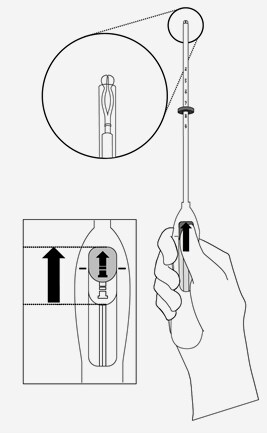
IMPORTANT!
Do not pull the slider downwards as this may prematurely release the LNG-IUS.
Once released, the LNG-IUS cannot be re-loaded
3
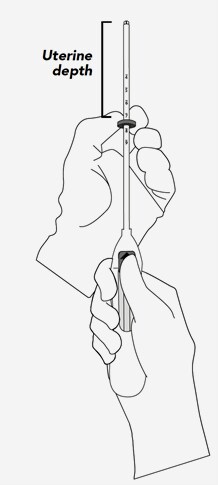
Holding the slider in the furthest position, set the upper edge of the flange to correspond to the sound measurement of the uterine depth.
- Mirena SmPC Bayer PLC. Return to content
4
While holding the slider in the furthest position, advance the inserter through the cervix until the flange is approx. 1.5 - 2.0 cm from the uterine cervix.
- Mirena SmPC Bayer PLC. Return to content
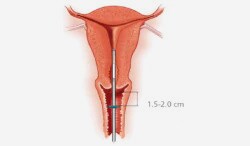
IMPORTANT!
Do not force the inserter. Dilate the cervical canal, if necessary.
5
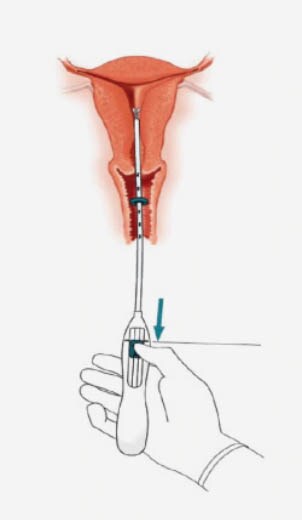
While holding the inserter steady, pull the slider to the mark to open the horizontal arms of the LNG-IUS. Wait 5-10 seconds for the horizontal arms to open completely.
- Mirena SmPC Bayer PLC. Return to content
6
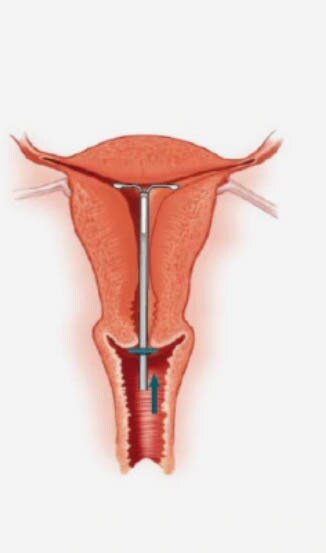
Advance the inserter gently towards the fundus of the uterus until the flange touches the cervix. The LNG-IUS is now in the fundal position.
- Mirena SmPC Bayer PLC. Return to content
7
Holding the inserter in place, release the LNG-IUS by pulling the slider all the way down. While holding the slider all the way down, gently remove the inserter by pulling it out. Cut the threads to leave about 2-3 cm visible outside of the cervix.
- Mirena SmPC Bayer PLC. Return to content
IMPORTANT!
Should you suspect that the system is not in the correct position, check placement (e.g. with ultrasound). Remove the system if it is not positioned properly within the uterine cavity. A removed system must not be reinserted.
Practical aspects of fitting an IUD1
The IUD may be used by trained medical staff only. We recommend using sterile gloves to minimise the risk of contamination.
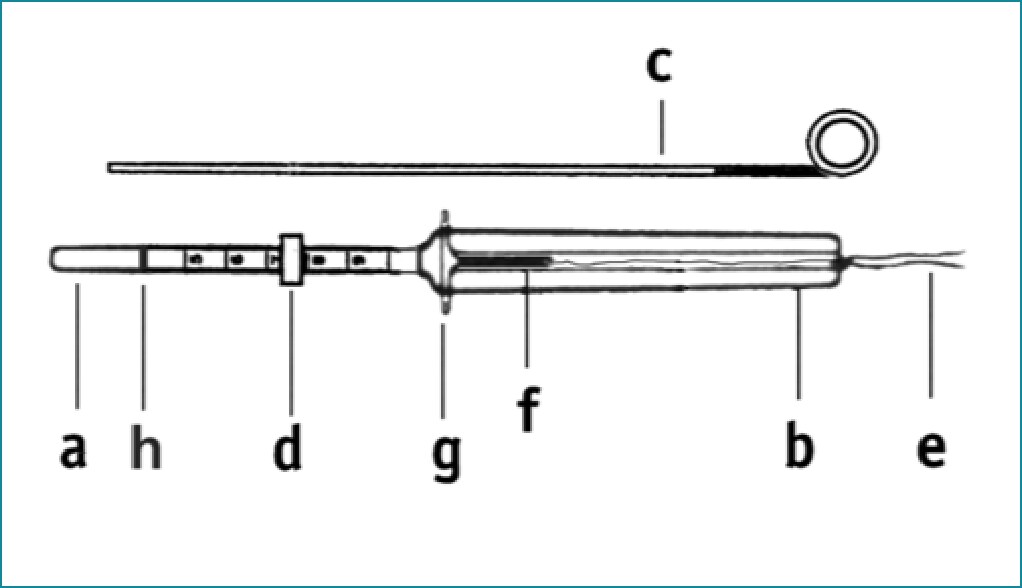
- Insertion tube
- Insertion body
- Plunger
- Blue flange
- Nylon threads
- IUD stem
- Side arms
- Blue marking
Steps 1 & 2
- Open the sterile packaging of the T-Safe® CU 380A QL.
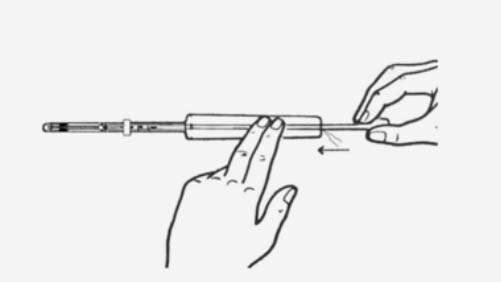
- While holding the nylon threads (e) straight, place the plunger (c) into the insertion body (b) up to the lower end of the IUD stem (f). By carefully pushing the plunger up to the blue marking on the insertion tube (a), both side arms (g) of the IUD slip into the tube. The upper end of the now ready-loaded IUD must jut only 2 mm out of the insertion tube.
Steps 3 & 4
- Adjust the sliding blue flange (d) so that the length of the insertion tube above it corresponds to the depth of the uterus as previously measured by hysterometry. Ensure that the wider part of the flange is parallel to the side arms of the ready-loaded IUD as this Indicates the direction in which the side arms of the IUD will open in the uterus.
- Carefully introduce the insertion tube with the loaded T-Safe® CU 380A QL into the uterine cavity until it touches the fundus of the uterus. The sliding blue flange must be in contact with the cervix.
Steps 5 & 6
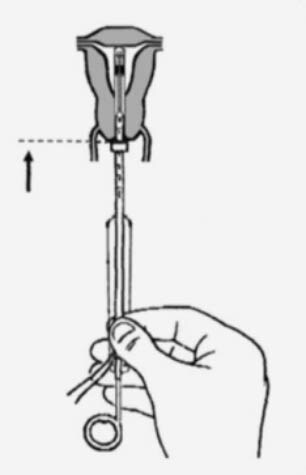
- Holding the plunger steady, pull the insertion body downwards to the base of the plunger. The side arms of the IUD are now entirely released in the uterus.
- To prevent pulling the device from its fundal position, first remove the plunger while keeping the insertion body steady and only then remove the insertion body. Cut the threads leaving 2-3 cm visible outside the cervix.

NOTE: Due to the soft and flexible insertion tube, the side arms may twist while being pushed upwards. Please adjust the sliding blue flange as described in step 3, above. The side arms of the T-Safe® CU 380A QL must not remain bent for over five minutes within the insertion tube, or they may not bend back completely and may not return to their original 90° angle.
REMOVAL: T-Safe® CU 380A QL should be replaced after ten years.
- T Safe CU 380A QL Intrauterine Contraceptive Device, Physicians Instructions, EurimPharm. Return to content
Potential problems at the time of insertion
Vasovagal collapse/cervical shock:
- Stop the procedure, lower the head and/or raise the legs. The IUD/IUS may need to be removed. An assistant shouldmonitor observations. Ensure a clear airway. ‘ABC approach’ in basic resuscitation.
- Oxygen and suction as required. Consider use of atropine IV/IM for persistent bradycardia. Consider use of adrenalineIM 1:1000 for management of anaphylaxis.
- Automated external defibrillator (AED) should be available. Arrange ambulance transfer if there is no improvement.
Syncope:
- Syncope may be experienced at insertion secondary to vagal stimulation from the cervix.1 Bradycardia is more common in nulliparous women.2
Suspected uterine perforation:1
- If perforation is suspected at the time of insertion, stop the procedure and monitor observations. Ultrasound or plain abdominal film to locate the device should be arranged as soon as possible, depending on device.
- Mirena® Product Monograph Return to content
- Farmer M, Webb A; Intrauterine device insertion-related complications: can they be predicted? J Fam Plann Reprod Health Care. 2003 Oct;29(4):227-31. Return to content
Post-insertion advice
Provide patients with a patient information leaflet and advice post-insertion of IUS/IUD is an important component of patient care.
Key advice to be offered includes:1

Expect cramping that usually lasts for 24-48 hours, but may last longer and resolves thereafter and usually does not persist.

Informing the patient on how to feel the threads (e.g. before the next episode of sexual intercourse and after her next menses) and advise her to seek medical advice if she is unable to feel them.
It may also be worthwhile discussing:

Bleeding

Infection

If the patient is feeling well enough to leave and is comfortable

Ensure documentation completed

A follow-up appointment with the patient for 6 weeks’ time
- Mirena® Product Monograph Return to content
Good practice points for documentation1
Detailed documentation is a key component of good practice in IUS/IUD fitting. Important points to document include:
- Faculty of Sexual and Reproductive Healthcare. Service Standards for Record Keeping in Sexual and Reproductive Healthcare Services, July 2019.
Available at: https://www.fsrh.org/standards-and-guidance/documents/fsrh-service-standards-for-record-keeping-july-2019/. Last accessed: June 2020. Return to content
Mirena® (52 mg Levonorgestrel) insertion, removal and replacement
Step-by-step video guidance for the preparation, insertion, removal and replacement of the Mirena® IUS.
Recommendations